

Knowledge of the Roots
"First understand the roots. Once the roots become alright, the rest of the tree will become alright by itself. This is the significance of Sahaja Yoga: first the root is awakened."
— H. H. Shri Mataji Nirmala Devi
Your Inner Map
Just as a map helps us navigate the outer world, the subtle system serves as an inner map, guiding us toward balance and a deeper connection with our true self. This subtle system is the network of energy centers (chakras) and channels (nadis) which governs our physical, mental, emotional, and spiritual well-being.
Kundalini
At the base of the subtle system lies a living, transformative force known as the Kundalini. This nurturing energy is the source of our spiritual ascent.
When awakened through Self-Realisation, the Kundalini rises through our subtle system. When the Kundalini emerges out of the seventh chakra at the top of the head, The Sahasrara, we get connected to the all-pervading divine power that surrounds and sustains all creation. This experience opens the door to a deeper state of meditation, inner silence, and awareness.


Chakras
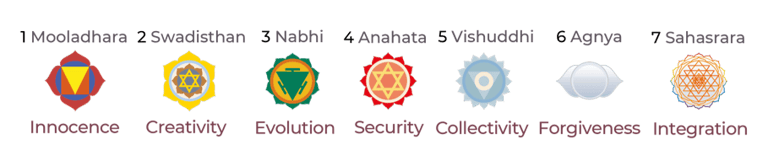
Within the subtle system are seven main energy centres called chakras, located along the spine. These chakras act like subtle regulators that not only influence different aspects of our physical and mental being, but also shape our personality. Each chakra manifests certain innate qualities — such as innocence, creativity, generosity, love, and forgiveness. These qualities are naturally present within every human being, though they may not always be fully expressed in our daily life.
Through Sahaja Yoga meditation, when the Kundalini awakens and rises through the subtle system, it nourishes the chakras and brings them into balance. As this happens, the positive qualities associated with each centre begin to manifest naturally in our ideas, emotions, and actions.

Nadis
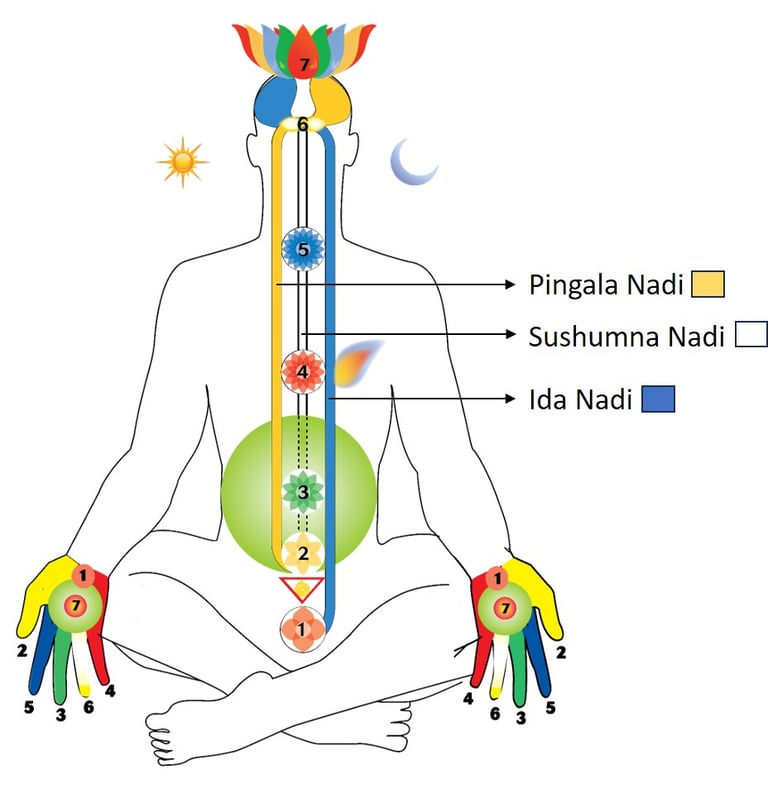
Alongside the chakras, the subtle system includes three main energy pathways known as nadis, namely the Ida Nadi, Pingala Nadi, and Sushumna Nadi. Each channel governs a different dimension of our inner functioning — our emotions, our activity, and our inner evolution. When these channels work in harmony, we experience a natural state of stability and clarity.
Ida Nadi — The Left Channel
The Ida Nadi, or the moon channel on the lefthand side, relates to our emotions, memories, and desires. It is connected with our experiences of the past, and also stores our habits, conditioning, and emotional patterns. When balanced, the left channel allows us to experience deep joy, compassion, and emotional sensitivity.
Pingala Nadi — The Right Channel
The Pingala Nadi, or the sun channel on the righthand side, governs our mental and physical activity, including planning, analysis, and the ability to take action. This channel provides the energy we use for work, thinking, and pursuing our goals. When balanced, the right channel brings clarity, dynamism, and effective action.
Sushumna Nadi — The Central Channel
The Sushumna Nadi, runs through the centre of the subtle system from the base of the spine to the top of the head. Representing the path of balance and spiritual evolution, it is through this channel that the Kundalini rises during Self-Realisation. When our attention settles in the central channel, we experience the present moment in a peaceful state of thoughtless awareness.
What is Self-Realisation?
Self-Realisation is the awakening of the Kundalini energy, through which a person becomes aware of their deeper spiritual nature.
In Sahaja Yoga, this awakening is a living experience and not merely a concept or belief. After Self-Realisation, we get connected with the all-pervading divine power of the universe.
This connection is often experienced as a pleasant cool breeze on our palms and the top of the head. It also brings about the meditative state of thoughtless awareness where the mind becomes silent while the attention remains fully alert.
Self-Realisation marks the beginning of a journey in which meditation gradually aligns us and leads us to find true, lasting peace and joy.
Foretold by Saints
Throughout history, saints and spiritual teachers from different cultures have spoken of a time when human beings would achieve a higher spiritual awareness. Ancient scriptures often refer to the awakening of inner energy, the opening of the thousand-petalled lotus, or the experience of union with the divine presence within.
Though the words differed across traditions, many pointed toward the same possibility: that everybody carries within them a latent spiritual power that, once awakened, leads to inner transformation and collective harmony.


v 13th century poet and philosopher Sant Gyaneshwar in Dnyaneshwari, his commentary on the Bhagavad Geetha, has referred to Kundalini as the Jagdamba – the universal energy of creation and sustenance, the one who controls the chakras and is the ultimate manifestation of pure consciousness (Chaitanya).


v As described in the holy Koran, Prophet Mohammed has talked about Kiyama, or the resurrection – the time of judgement when our “hands will speak”. This is precisely what happens in Sahaja Yoga, where the state of our subtle system can be felt on our fingertips.
v Lord Jesus Christ has spoken of the cool breeze of the Holy Ghost or Holy Spirit. This is the experience of the Kundalini rising, which manifests itself as a cool breeze flowing on our palms, out of the top of our head and, sometimes, even through our whole body.
v Shri Adishankaracharya, considered as one of the foremost scholars of Hinduism, wrote the Saudarya Lahiri, a 100-verse hymn in praise of the Goddess. In this he describes the rising of the Kundalini and its manifestation as ”Salilam, Salilam” – the experience of cool, soothing vibrations.
v Guru Nanak ji talked time and again of Self-Realisation and the need to look within. For instance: “Kahe Nanak bin aapa cheenhe mite na bhram ki kai”. This verse says that doubts and confusions can only be dispelled if one knows oneself (Self-Realisation).
v Through his beautiful, poetic expressions, Sant Kabirdas has described the experience of kundalini awakening. “Shoonya shikhar par anahad baje”, he says, making a metaphoric reference to the pulsations/vibrations (anahad) at the peak or the Sahasrara chakra on top of the head (shoonya shikhar).
In ancient times, the knowledge of the kundalini was shared only within close teacher–disciple traditions. Spiritual seekers often spent several years under the guidance of a guru, practicing intense disciplines and penance in the hopes of achieving Kundalini awakening. A very small number of seekers were believed to have attained it.
Today, this incredible experience is accessible to everyone through Sahaja Yoga. All it takes to begin is the sincere desire for spiritual ascent.
Sahaja Yoga and Science
In recent decades, meditation has increasingly been explored through scientific research and medical observation. It is also interesting that the subtle system shows clear parallels with human physiology. For instance, the locations of the chakras correspond closely with major nerve plexuses and endocrine centres within the body.
Dr. Ramesh Manocha, an Australian general practitioner and research fellow at the Natural Therapies Unit of the Royal Hospital for Women in Sydney, has published findings which record the positive effects of Sahaja Yoga meditation in the prevention and management of conditions such as hypertension, stress, menopause-related disorders, ADHD, and asthma.
A group of doctors and researchers carried out studies to assess the influence of Sahaja Yoga on certain health and well-being indicators. They observed that Sahaja Yoga meditation brings about significant improvements in quality of life, anxiety reduction, and blood pressure control.
Validated by Experience


While insightful studies on Sahaja Yoga and its effects continue, many practitioners emphasize that the most meaningful validation comes through direct personal experience – the inner peace, clarity, and balance that arise through regular meditation.
A growing body of research has also explored the effects of Sahaja Yoga meditation on physical and mental health. Studies conducted in medical and academic settings have reported positive outcomes across a range of conditions. The examples below highlight just a few of these findings.